Why sandpaper isn't enough, and how mastering the file and rasp will transform your DIY projects.
The Difference Between "Done" and "Perfect"
You've cut. You've drilled the hole. You've printed the model. But when you try to fit the parts together, they stick. Or worse, the edges look rough, amateur, and unfinished.
Most people grab a piece of sandpaper and scrub away for 20 minutes, ruining the sharp edges of their project.
The Pro Secret? You don't need sandpaper yet. You need files and rasps.
In this free mini-course, we will teach you the art of Material Shaping. Whether you are working with hardwood, steel, or 3D printed PLA, the principles are the same. And to do it right, you need the right arsenal.
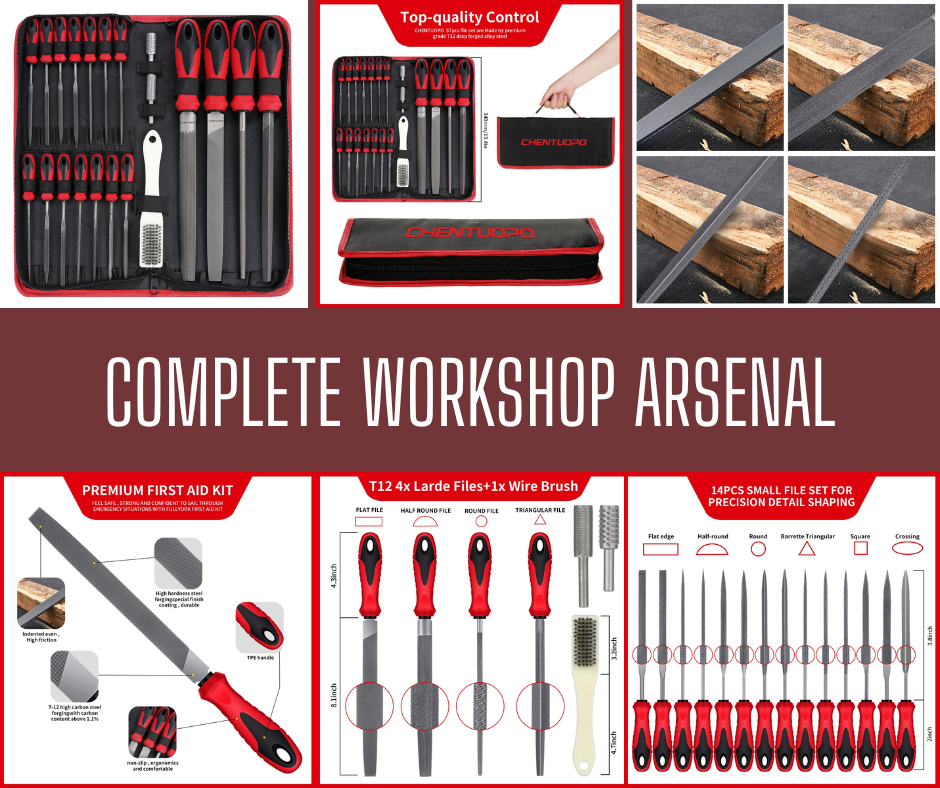
(This guide is on the comprehensive 57-Piece Grade T12 Alloy Steel File Set—the ultimate toolkit for precision work.)
1The Material Matters (Why "T12" Steel?)
Before we touch a tool, you need to understand Hardness.
If you use a cheap file on a piece of metal, the metal will actually eat the file. You need tools harder than the material you are working on.
The Rule: Always check your file grade. The 57-Piece set we recommend uses T12 Steel exclusively, meaning these tools will likely outlast your next 100 projects.
2The "Big 4" (Shaping the Macro)
In your kit, you will see four large files. Here is exactly when to use each one:
3The Art of the "Needle" (Detail Work)
Have you ever looked at a jewelry piece or a high-quality 3D print and wondered, "How did they get inside those tiny cracks?"
The answer: Needle Files.
A standard file is too clumsy for fine detail.
- For 3D Printers: Needle files are essential for removing support marks from PLA/PETG without melting the plastic.
- For Model Makers: Perfect for removing "flash" (excess plastic) from mould lines.
- For Woodworkers: Ideal for cleaning up intricate carving or inlay work.
Note: The 57-Piece set includes 14 distinct needle files that cover every geometric shape.
4Technique (Stop "Sawing")
It is the #1 mistake beginners make. They move the file back and forth like a saw.
STOP.
The "Forward Stroke" Rule:
- Files only cut in one direction (pushing forward).
- Push the file across the material with steady pressure.
- Lift the file off the material.
- Return to the start.
- Repeat.
If you drag the file backward, you dull the teeth and ruin the tool.
5Maintenance (The Brush)
Even with T12 steel, files get clogged. If your file stops cutting, it's not dull—it's dirty.
You need a Wire Carding Brush. Use this to clean the file's "grooves" after every use.
(Yes, the 57-Piece Master Set includes the cleaning brush and a carrying case to keep them organized.)
One Kit to Rule Them All
You could go to the hardware store and buy a flat file for $12, a round file for $10, and a set of cheap needle files for $15.
Or, you can equip your workshop for life with a single box.
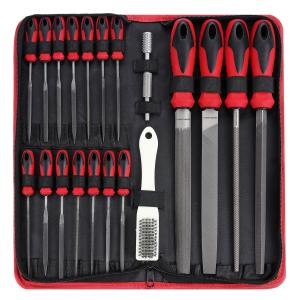
57-Piece Metal and Wood File Rasp Set
This versatile set has everything you need to shape, smooth, and refine your wood projects with ease
Product information
$88.92
$30.23
Product Review Score
4.55 out of 5 stars
151 reviews
Product links
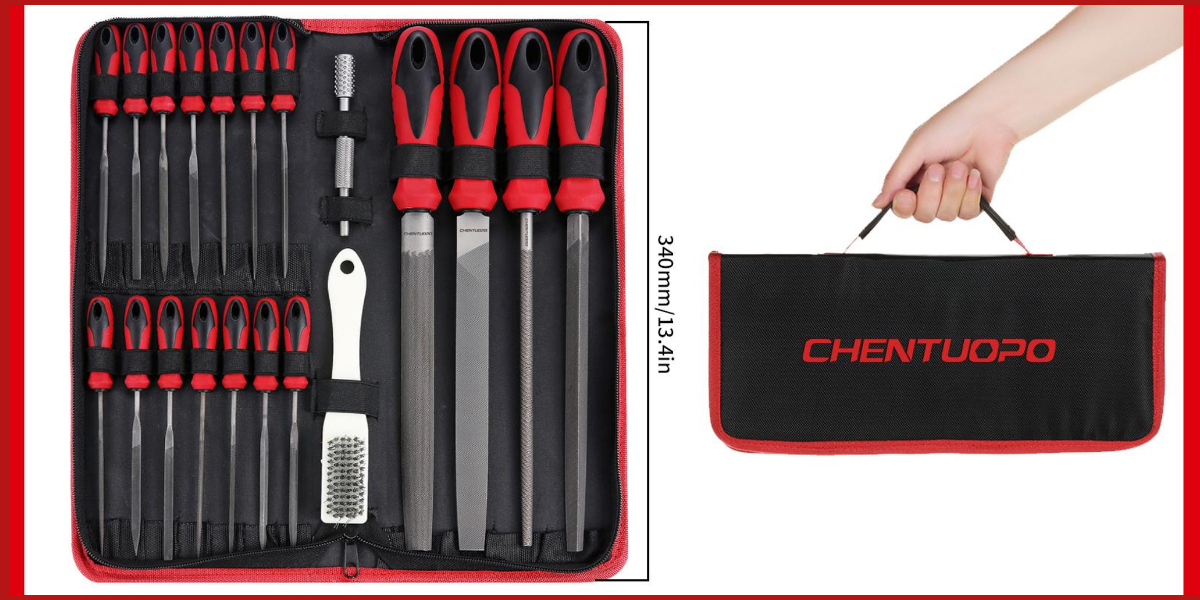
57-Piece Metal and Wood File Rasp Set
This versatile set has everything you need to shape, smooth, and refine your wood projects with ease
Product information
$88.92 $30.23
Product Review Score
4.55 out of 5 stars
151 reviewsProduct links