🛏️
How To End Bedtime Battles Forever Without Sacrificing Your Sanity (Or Your Storage Space)
The proven 3-part system that transforms your child's bedroom from chaotic war zone to an organized sanctuary they'll be EXCITED to sleep in.
📌 What You'll Discover Inside This Guide
Inside this comprehensive guide, you'll learn the exact 3-part system that helps busy parents transform cramped, chaotic children's bedrooms into organized sanctuaries that kids actually WANT to sleep in.
You'll discover:
- The "Square Footage" Solution – How to reclaim 20+ square feet of floor space without moving walls
- The "Bedtime Battle" Strategy – Why kids fight sleep and the ONE psychological shift that changes everything
- The "Future-Proofing" Framework – How to buy furniture once that lasts 10+ years instead of 2
- The "Safety Anxiety" Antidote – What to look for so you sleep soundly knowing your kids are safe
By the end of this guide, you'll have a clear action plan to implement these solutions in your home—and you'll understand exactly what to look for when choosing the right bed for your family.
Why Most Parents Are Stuck in the Bedtime Battle Cycle (And How to Break Free)
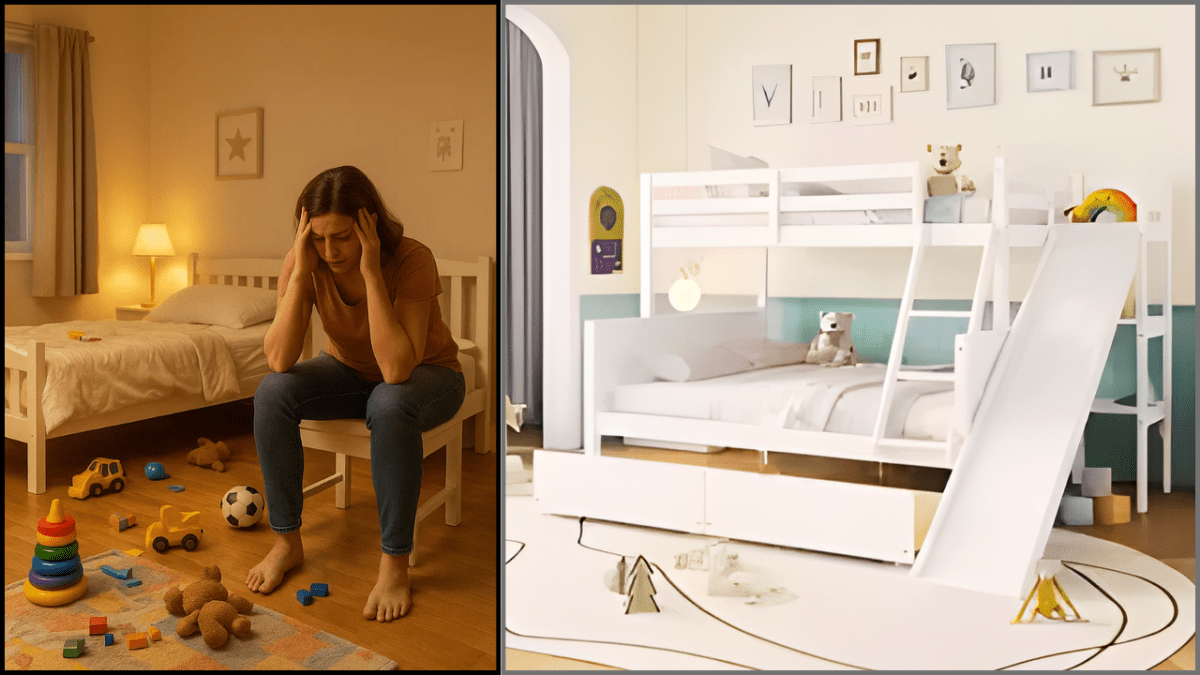
If you're reading this, you probably know the feeling: You walk past your child's bedroom and feel a wave of stress wash over you. Toys scattered across the floor. Clothes piled on chairs. No space to move. And then bedtime arrives, and it's like negotiating with a tiny dictator.
Here's what's really happening: Your child's bedroom isn't just a sleeping space—it's become a symbol of chaos. And kids can sense that. They associate their room with stress, clutter, and being sent away. So of course, they fight sleep.
But here's the thing: The problem isn't your kids. The problem is the room itself.
Most parents try to solve this by:
- Buying more storage bins (which just move clutter around)
- Forcing kids to "clean their room" (which creates power struggles)
- Installing a standard bunk bed (which takes up as much space as two separate beds)
- Accepting the chaos as "just part of having kids."
None of these work. Because they don't address the root problem: The room design itself is working against you.
What if there was a different way? What if you could design a bedroom that naturally creates order, makes kids EXCITED to sleep, and actually grows WITH your family?
That's exactly what this guide is about.
1The "Square Footage" Solution: Reclaim 20+ Square Feet Without Moving Walls
This is what we call the "Tetris Room" problem. Every piece of furniture is a puzzle piece, and no matter how you arrange it, something doesn't fit.
A traditional twin bed takes up about 39 sq. ft. of floor space (including the footprint). Add a dresser (16 sq. ft.), a bookcase (12 sq. ft.), and a nightstand (8 sq. ft.), and you've used up 75 sq. ft. of a 100 sq. ft. room. That leaves only 25 sq. ft. for everything else—and kids need space to move, play, and breathe.
Then there's the "Clutter Cycle": Without enough storage, clothes pile up on chairs. Toys stay on the floor. Every time you walk past the room, you feel stress. Your kids feel it too.
The solution is simple but powerful: Stop thinking horizontally. Start thinking vertically.
Here's how this works:
- Stacking sleeping areas reclaims ~20 sq. ft. of floor space immediately
- Built-in drawers (2 integrated drawers) replace a bulky dresser—you get the storage without the footprint
- 2-tier shelves replace a bookcase—books and toys have a home without taking up floor space
- You're removing 2-3 pieces of furniture but keeping all the utility
The Math:
Before: Twin bed (39 sq. ft.) + Dresser (16 sq. ft.) + Bookcase (12 sq. ft.) = 67 sq. ft. used, 33 sq. ft. remaining
After: Twin-Over-Full Bunk with Storage (42 sq. ft.) + No separate dresser/bookcase = 42 sq. ft. used, 58 sq. ft. remaining
Result: You've reclaimed 25 sq. ft. of usable floor space.
- Measure your room – Know your exact dimensions before choosing a bed
- Choose a bed with integrated storage – Drawers, shelves, and compartments built into the frame
- Remove existing furniture – Donate or repurpose the old dresser and bookcase
- Organize strategically – Use the drawers for clothes, shelves for books/toys, under-bed space for seasonal items
- Keep it minimal – Only keep items that serve a purpose or bring joy
2The "Bedtime Battle" Strategy: Transform Sleep from a Chore to an Adventure
This isn't actually about sleep resistance. It's about psychology. Your child's brain has learned to associate their room with being sent away, isolation, and missing out on the fun happening downstairs.
You've probably tried:
- Bedtime routines (they still fight it)
- Reward charts (they work for a week, then stop)
- Consequences (creates power struggles)
- Negotiation (exhausting)
The reason these fail is that they don't change the room's emotional association. You're trying to motivate a child to go somewhere they don't want to be.
Here's the insight: Kids don't resist sleep. They resist boredom and missing out. If their room is the most exciting place in the house, they'll want to go there.
A slide on a bunk bed is more than just fun—it's a psychological tool. Here's why:
- Introduce the slide as a "special feature" – Make it feel like a privilege, not a gimmick
- Let kids practice sliding during the day – Build positive associations before bedtime
- Make bedtime the reward – "You get to sleep in the cool bed with the slide tonight"
- Use the slide for morning motivation – "First one to slide down gets to pick breakfast."
- Celebrate the transition – Make moving to the new bed a big deal, not a chore
Real Parent Feedback:
"We were shocked. Our 6-year-old who used to fight bedtime for 45 minutes now asks to go to bed early so she can slide down in the morning. It's like we flipped a switch in her brain."
3The "Future-Proofing" Framework: Buy Once, Use for 10+ Years
This is the "Toddler Bed Trap." You buy something for your 5-year-old, and by age 8, it's outgrown. By age 12, it looks ridiculous. So you buy again. And again.
It's wasteful, expensive, and frustrating.
Standard twin-over-twin bunk beds have a shelf life of about 3-5 years because:
- They look "too babyish" for teenagers
- Twin mattresses are too small for older kids and parents
- They can't be separated or reconfigured
- They're built for "stacking" not for actual use as two separate beds
The solution is a bed that grows with your family and adapts to changing needs.
Here's why this works:
The Twin-Over-Full Advantage:
Years 1-5 (Ages 5-10): Use as a bunk bed. The top twin is perfect for the younger child, the bottom full is spacious for the older child.
Years 5-8 (Ages 10-13): Kids can still share, but now they have more personal space. The full-size bottom bed is comfortable for a growing pre-teen.
Years 8-10+ (Ages 13+): Split the beds into two separate full-size beds. Each child has their own space. The beds look modern and age-appropriate, not "babyish."
Here's something most parents don't think about until it happens: When your child is sick or has a nightmare, you want to be able to lie down next to them. A standard twin bunk is too cramped for a parent to fit comfortably.
A full-size bottom bed changes this. You can lie next to your child, provide comfort, and actually rest yourself. This is huge for both the child's emotional security and the parent's sanity during tough nights.
- Choose a bed with convertible design – Make sure it can actually be split into two separate beds (not just theoretically)
- Verify the full-size mattress quality – This will be used for 10+ years, so durability matters
- Plan for the split – Know where the two separate beds will go when the time comes
- Invest in quality – A solid wood bed costs more upfront but lasts 10+ years. Cheap particle board fails in 2-3 years
- Think about aesthetics – Choose a design that looks good as a bunk AND as two separate beds
4The "Safety Anxiety" Antidote: Sleep Soundly Knowing Your Kids Are Safe
This is the emotional pain point that keeps parents up at night. You want your kids to have fun, but not at the expense of safety.
Particle board and low-quality materials might seem like a good way to save money, but they create real safety issues:
- Wobbling: The bed shifts and moves when kids climb or jump
- Cracking: Particle board cracks under weight, compromising structural integrity
- Fastener failure: Cheap bolts and screws loosen over time
- Guardrail issues: Inadequate or poorly designed guardrails don't prevent falls
- Mattress support: Weak slats sag, causing mattresses to dip dangerously
Here's what to look for:
- Read the safety specifications – Don't skip this. Check weight capacity, guardrail height, and material composition
- Look for certifications – CPSC (Consumer Product Safety Commission) compliance is non-negotiable
- Check customer reviews for safety concerns – Read the 1-star reviews first. Look for patterns of wobbling, cracking, or guardrail issues
- Verify assembly quality – Poor assembly instructions lead to improper installation and safety issues. Clear instructions matter
- Test stability before kids use it – Once assembled, shake the bed gently. It should feel rock-solid, not wobbly
- Perform regular maintenance – Tighten bolts every 3-6 months, especially if kids are active
The Real Cost of Cheap Beds:
A $300 particle board bed might fail in 2 years, requiring replacement. That's $150/year.
A $800 solid wood bed lasts 10+ years. That's $80/year.
Plus, you avoid the stress, safety concerns, and hassle of replacing a failed bed.
5Putting It All Together: Your Action Plan
Now you understand the four core problems and how to solve them. But knowing and doing are two different things. Here's your action plan:
- Measure your child's bedroom (length, width, ceiling height)
- List the current furniture and what it's being used for
- Identify pain points: space, clutter, bedtime battles, safety concerns
- Determine how many kids will share the room and their ages
- How much floor space do you want to reclaim?
- What would make bedtime easier?
- How long do you want this bed to last?
- What's your budget?
- Look for a twin-over-full bunk bed with integrated storage
- Verify it's made from solid wood or high-quality rubberwood
- Check the weight capacity (minimum 400 lbs per mattress)
- Read reviews, focusing on safety and durability
- Confirm it can be split into two separate beds later
- Declutter and organize current items
- Plan what furniture will be removed
- Involve kids in the excitement (show them pictures, let them help plan)
- Arrange delivery and assembly
- Assemble the bed carefully, following instructions exactly
- Test stability and safety features
- Let kids explore and get excited about the new setup
- Make the first night special (celebrate the transition)
- Organize storage and establish systems for maintaining order
Pro Tip:
Make the transition fun, not stressful. Let kids help decorate their new space, choose bedding, and arrange their belongings. This creates ownership and excitement, not resistance.
Ready to Transform Your Child's Bedroom?
You now understand the four core problems that create chaos in children's bedrooms and the proven solutions that actually work.
The next step is to find the right bed that solves all four problems at once: space efficiency, bedtime excitement, long-term value, and safety.
We've researched and tested dozens of options, and we've found one that checks every box.
Click below to see The Haven 3-in-1 Storage Bunk with Slide—the bed designed specifically for busy parents who want their sanity back.
This is the exact bed we recommend for solving all four problems. It's made from solid wood, has a 400 lb weight capacity, includes integrated storage, and features a safe, low-profile slide that kids actually get excited about.