The 7 Deadly Angle Grinder Mistakes
Why 83% of DIYers Fear This Essential Tool & How to Overcome Each One
Plus: The Ultimate Checklist for Selecting a Cordless Grinder That Performs Like a Corded Without the Hazards
Why Most DIYers Avoid the Angle Grinder (Even Though They Shouldn't)
The angle grinder is one of the most versatile tools in any workshop. It cuts rebar, grinds welds, carves wood, removes rust, and handles jobs that would take hours with any other tool.
Yet 83% of DIYers report anxiety or avoidance when it comes to using one.
The good news? Every single one of these fears has a solution. And once you understand what causes them, you can eliminate the risk and unlock the full potential of this essential tool.
This guide walks you through each mistake, why it happens, and exactly what to do instead. By the end, you'll know precisely what to look for in an angle grinder—and why the right choice makes all the difference.
1Choosing Corded When You Need Cordless (Or Vice Versa)
The Problem:
You're working on a large project—cutting a live-edge slab, grinding a car chassis, or fabricating metal art. You grab a corded grinder because you know it won't lose power. But within 20 minutes, you're tangled in an extension cord, tripping over it, or worse—the cord wraps around your workpiece and yanks the tool.
Alternatively, you buy a cordless model to avoid the cord hassle, but halfway through a critical cut, the battery dies or the motor bogs down under pressure. You're left frustrated and doubting whether cordless tools can handle real work.
Why This Happens:
- False Choice: Most people think it's either "corded power" or "cordless convenience"—not both.
- Battery Myths: Older cordless grinders genuinely lacked power. Many DIYers still believe this is true.
- Cord Anxiety Ignored: People underestimate how much a tethered tool impacts workflow and safety on large projects.
The Correct Strategy:
The modern solution is a brushless cordless grinder with sufficient torque to match corded performance. Here's what to evaluate:
| Factor | Corded Grinder | Modern Cordless (Brushless) |
|---|---|---|
| Power Delivery | Consistent, unlimited | Consistent with brushless motor |
| Mobility | Tethered to outlet | Complete freedom |
| Safety Risk | Cord entanglement | No cord hazard |
| Runtime | Unlimited | Depends on battery, but modern batteries last hours |
| Setup Time | Unroll cord, find outlet | Grab and go |
Implementation Steps:
- Verify Brushless Motor: This is non-negotiable. Brushless motors run cooler, transfer energy more efficiently, and won't stall under load like brushed motors.
- Check Torque Specs: Look for grinders rated at 50+ Nm (Newton-meters) of torque. This ensures it won't bog down on heavy cuts or grinding.
- Battery Compatibility: If you already own a brand's battery system (DeWalt, Makita, Milwaukee), choose a grinder that uses the same batteries. This saves money and ensures you have backups charged and ready.
- Test Under Load: If possible, try the tool on a similar material to your project. Push hard. If it doesn't stall or lose RPM, you've found your match.
2Ignoring the Electronic Brake & Clutch System
The Problem:
You're mid-cut when the wheel suddenly catches an edge. The tool jerks violently in your hand, nearly flying out of your grip. Your heart races. Your hands shake. You set the tool down and take a break—if you pick it up again at all.
This is kickback, and it's the #1 reason DIYers fear angle grinders. A tool without proper safety systems can cause serious injury.
Why This Happens:
- Basic Models Lack Protection: Budget grinders have no electronic safety systems. If the wheel catches, physics takes over—the tool jerks, and you're at risk.
- Mechanical Clutches Are Slow: Older mechanical clutches take 1-2 seconds to disengage. In a kickback situation, that's an eternity.
- Safety Features Seem "Unnecessary": Until you experience a catch, it's easy to dismiss safety systems as marketing hype.
The Correct Strategy:
Demand an Electronic Brake (E-Brake) and Electronic Clutch (E-Clutch) system. Here's what these do:
🔒 WHAT E-BRAKE & E-CLUTCH DO
E-Brake: When you release the trigger, the motor cuts power instantly and the wheel stops in less than 2 seconds (compared to 5-10 seconds on basic models). This dramatically reduces the risk of the spinning wheel catching your hand or workpiece.
E-Clutch: If the wheel suddenly catches or stalls (pinch detection), the motor automatically cuts power before the tool can jerk violently. You maintain control.
Implementation Steps:
- Verify Both Systems: Don't settle for just an E-Brake. Confirm the grinder has both E-Brake and E-Clutch (pinch detection).
- Test the Stop Speed: If possible, run the tool and time how quickly it stops after releasing the trigger. Under 2 seconds is ideal.
- Understand the Feel: With E-Clutch active, if you push too hard and the wheel catches, you'll feel the motor cut power. This is the system working—not a malfunction.
- Practice Safe Grip: Even with these systems, always use a two-handed grip with thumbs wrapped around the handle. Never grip with thumbs on top.
3Overlooking Dust & Debris Protection
The Problem:
You're grinding metal or sanding wood. Fine particles are flying everywhere. You don't think much about it—until your grinder starts making a weird noise, loses power, and eventually dies. You've just killed the motor.
Dust and metal filings are the #1 killer of angle grinders. They get sucked into the motor's air intake vents, clog the cooling system, and cause overheating and failure.
Why This Happens:
- Vents Are Unprotected: Most budget grinders have open air intake vents. Dust flows directly into the motor.
- Invisible Damage: You don't see the problem until the tool fails. By then, it's too late.
- Warranty Doesn't Cover It: Dust damage is often considered "user error," so repairs aren't covered.
The Correct Strategy:
Choose a grinder with mesh dust guards that cover the air intake vents. This simple feature prevents debris from entering the motor while still allowing adequate airflow for cooling.
🛡️ HOW MESH DUST GUARDS WORK
Mesh guards act as a filter, allowing air to pass through for motor cooling but blocking dust, wood filings, and metal particles. This extends motor life dramatically, especially during heavy sanding or grinding operations.
Implementation Steps:
- Inspect the Vents: Before buying, look at the motor housing. Are the air intake vents covered with mesh or open?
- Check for Removable Guards: Ideally, the mesh guard should be removable for cleaning. You'll want to clear dust buildup periodically.
- Plan for Maintenance: Even with guards, plan to clean the vents every 5-10 hours of heavy use. Use compressed air or a soft brush.
- Consider Your Material: If you'll be doing heavy metal grinding or wood sanding, dust protection is critical. Don't compromise on this feature.
4Choosing the Wrong Disc Size for Your Project
The Problem:
You're cutting rebar or carving a live-edge slab, and you realize your 4.5-inch grinder doesn't have enough cutting depth. You're making shallow passes, wasting time, and the smaller disc heats up faster. Alternatively, you bought a 9-inch grinder for light work, and it's overkill—heavy, hard to control, and exhausting to use.
Disc size directly impacts cutting depth, material removal speed, and control. Choosing wrong means frustration and wasted effort.
Why This Happens:
- Assumption All Sizes Are Equal: People think "a grinder is a grinder" without considering how disc size affects capability.
- Budget Bias: Smaller grinders are cheaper, so people buy them without matching to their actual projects.
- Lack of Real-World Testing: You don't know what you're missing until you try the right size.
The Correct Strategy:
Match disc size to your primary use case. Here's the breakdown:
| Disc Size | Best For | Cutting Depth | Control Level |
|---|---|---|---|
| 4.5" | Light grinding, detail work, tight spaces | Shallow (1-2") | Excellent |
| 5" (125mm) | Balanced: cutting pipes, rebar, wood carving | Moderate (2-3") | Excellent |
| 7" | Heavy-duty cutting, thick materials | Deep (3-4") | Good |
| 9" | Professional-grade, large-scale projects | Very Deep (4-5") | Harder to control |
Implementation Steps:
- Define Your Primary Use: What's the #1 project you'll use this grinder for? (Cutting rebar? Carving wood? General grinding?)
- Check Material Thickness: What's the thickest material you'll need to cut? Match the disc size to achieve that depth in one pass.
- Consider Control: Larger discs are more powerful but harder to control. If you prioritize precision, go smaller.
- Think Versatility: A 5-inch (125mm) grinder is the sweet spot for most DIYers. It handles rebar, pipes, wood carving, and grinding with excellent control.
5Underestimating the Importance of Brushless Motor Technology
The Problem:
You buy a budget grinder with a brushed motor to save money. At first, it works fine. But after a few months of regular use, you notice it's getting hot, losing power, and the performance is declining. Within a year, it's dead. You're back to shopping for a replacement.
Meanwhile, a colleague with a brushless grinder is still running strong after two years. Same price point, completely different outcome.
Why This Happens:
- Brushes Wear Out: Brushed motors have carbon brushes that make contact with the motor's commutator. Over time, these brushes wear down, reducing efficiency and eventually causing failure.
- Heat Buildup: Brushed motors generate more heat during operation. This accelerates wear and can cause the tool to shut down during heavy use.
- Efficiency Loss: Energy is wasted as heat, meaning less power reaches the wheel and battery drains faster.
The Correct Strategy:
Invest in a brushless motor. Yes, it costs more upfront, but the long-term value is undeniable:
⚡ WHY BRUSHLESS MOTORS WIN
No Brushes to Replace: Brushless motors use electronic commutation instead of physical brushes. There's nothing to wear out.
Runs Cooler: More efficient energy transfer means less heat. The motor stays cooler even during extended use.
Longer Runtime: Better efficiency means the same battery lasts longer per charge.
More Torque: Brushless motors deliver consistent power without the performance drop of brushed motors.
Longer Tool Life: A brushless grinder can last 5+ years of regular use. A brushed motor might last 1-2 years.
Implementation Steps:
- Check Specifications: Before buying, verify the motor is brushless. It should be clearly stated in the product specs.
- Calculate True Cost: A brushless grinder costs $50-100 more upfront, but lasts 3-5x longer. The cost per year of use is actually lower.
- Verify Brand Support: Brushless motors are standard on quality brands (DeWalt, Makita, Milwaukee). If a brand doesn't offer brushless, that's a red flag.
- Plan for Longevity: With a brushless motor, you're not replacing this tool in a year. You're investing in a tool that will be in your workshop for years.
6Forgetting About Battery Ecosystem & Compatibility
The Problem:
You buy a cordless grinder from Brand X because it's on sale. It works great—for a while. But then you realize the batteries are expensive, hard to find, and incompatible with any other tools you own. You're locked into Brand X's ecosystem, and it's costing you money.
Worse, if Brand X discontinues that battery model, you're stuck with a tool you can't power.
Why This Happens:
- Short-Term Thinking: People focus on the tool's price, not the long-term cost of batteries and compatibility.
- Ecosystem Lock-In: Each brand has proprietary batteries. Choosing the wrong brand means future purchases are limited.
- Lack of Foresight: You don't realize how valuable battery compatibility is until you're buying your second or third tool.
The Correct Strategy:
Choose a grinder from a brand whose battery ecosystem you already own—or plan to build. Here's why:
🔋 BATTERY ECOSYSTEM BENEFITS
Shared Batteries: If you own DeWalt tools, a DeWalt grinder uses the same batteries. You can swap batteries between tools.
Lower Total Cost: You're not buying new batteries for each tool. One set of batteries powers multiple tools.
Flexibility: You can use the same charger for all your tools. No proprietary chargers cluttering your workshop.
Future-Proof: Major brands (DeWalt, Makita, Milwaukee) support their battery platforms for 10+ years. Your investment is protected.
Implementation Steps:
- Audit Your Current Tools: What brand batteries do you already own? (DeWalt, Makita, Milwaukee, Ryobi, etc.)
- Choose a Grinder from That Brand: This is the easiest path to compatibility and cost savings.
- If Starting Fresh: Choose a major brand with a robust ecosystem. DeWalt, Makita, and Milwaukee are the safest bets.
- Buy Extra Batteries: With a compatible grinder, invest in 2-3 extra batteries. Rotate them while one charges, and you'll never run out of power.
- Check Battery Availability: Before committing, verify the battery model is widely available and reasonably priced.
7Skipping the Safety Checklist Before Every Use
The Problem:
You're excited to start a project, so you grab the grinder, plug it in (or charge the battery), and go. You don't inspect the disc, don't check for damage, and don't verify the guard is in place. Halfway through, the disc shatters, or the guard is loose, or you discover a crack you missed. Now you're dealing with a dangerous situation.
Why This Happens:
- Overconfidence: After using a tool a few times, people get comfortable and skip safety steps.
- Time Pressure: You want to start the project, so you rush through setup.
- Invisible Damage: A hairline crack in the disc isn't obvious until it fails catastrophically.
The Correct Strategy:
Develop a pre-use safety ritual. This takes 60 seconds and prevents 90% of accidents. Here's the checklist:
✓ PRE-USE SAFETY CHECKLIST
1. Inspect the Disc: Look for cracks, chips, or damage. If you see anything, replace the disc. Don't risk it.
2. Verify the Guard: Confirm the guard is in place and secure. It should cover the top and sides of the disc.
3. Check the Handle: Ensure the side handle is attached and tight. You need a secure two-handed grip.
4. Test the Trigger: Squeeze the trigger gently. The motor should start smoothly without stuttering.
5. Verify Battery (if cordless): Check that the battery is fully charged and properly seated in the tool.
6. Clear the Work Area: Remove loose clothing, jewelry, and anything that could get caught. Tie back long hair.
Implementation Steps:
- Print the Checklist: Create a laminated card with the 6-point checklist and keep it in your workshop.
- Make It a Habit: Before every use, go through the checklist. It should become automatic, like putting on a seatbelt.
- Replace Discs Regularly: Don't wait for a disc to fail. Replace it every 20-30 hours of use, or sooner if you notice wear.
- Store Safely: Keep the grinder in a secure location where it won't fall or get damaged. Store discs in a protective case.
Your Action Plan: The Angle Grinder Selection Checklist
Now that you understand the 7 deadly mistakes, here's your complete checklist for selecting a grinder that delivers power, safety, and reliability:
Now that you understand the 7 deadly mistakes, here's your complete checklist for selecting a grinder that delivers power, safety, and reliability:
✓ The Complete Grinder Evaluation Checklist
Motor & Power:
- ☐ Brushless motor (non-negotiable)
- ☐ 50+ Nm torque rating
- ☐ Consistent power delivery under load
Safety Systems:
- ☐ Electronic Brake (stops in <2 seconds)
- ☐ Electronic Clutch (pinch detection)
- ☐ Secure guard covering disc
- ☐ Mesh dust guards on motor vents
Specifications:
- ☐ 5-inch (125mm) disc for versatility
- ☐ Cordless with compatible battery ecosystem
- ☐ Lightweight enough for extended use
- ☐ Secure two-handed grip
Reliability & Support:
- ☐ Reputable brand with proven track record
- ☐ Batteries compatible with other tools you own
- ☐ Readily available replacement parts and discs
- ☐ Strong warranty (2+ years)
Ready to Work Without Fear?
You now understand exactly what separates a dangerous angle grinder from a safe, reliable one. You know the 7 mistakes to avoid and the specific features that matter.
The next step is simple: Choose a grinder that meets your checklist and start your project with confidence.
If you're ready to experience the perfect balance of power, safety, and cordless freedom, we recommend exploring options that match your specific needs and budget.
$117.12
$46.17
4.3 out of 5 stars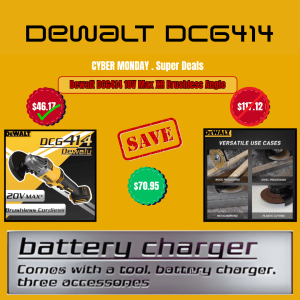
Dewalt 18V Max XR Brushless Angle Grinder, 125mm
Experience powerful performance and convenience for any metal or wood project with this versatile angle grinder
Product information
Product Review Score
Product links